In this guide, we will discuss the very cool feature of Kotlin which is ranges. With the help of ranges in Kotlin we can easily create a list of sequence by specifying starting and ending value. For example a range of 1..5 would create a series of values 1, 2, 3, 4, 5. Similarly we can create character ranges such as ‘A’..’D’ which will create a series of values A, B, C, D. We can also create ranges in reverse order and several other things with ranges. Lets get started.
A simple example of Kotlin Ranges
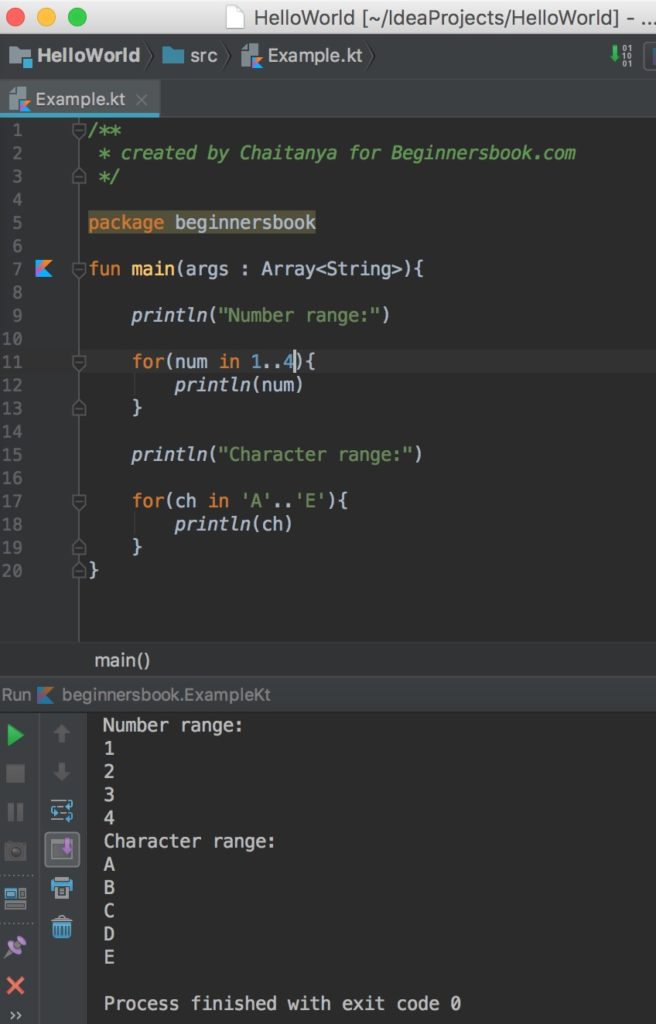
In the following example, we have created two ranges, one is an integer range and other one is a character range. We are cycling through the elements of the ranges using for loop.
/**
 * created by Chaitanya for Beginnersbook.com
 */

package beginnersbook

fun main(args : Array<String>){

    println("Number range:")

    for(num in 1..4){
        println(num)
    }

    println("Character range:")

    for(ch in 'A'..'E'){
        println(ch)
    }
}
Output:
Check element in Ranges
We can also check whether a particular element is present in the range or not. Lets see how to do this with the help of a simple example.
package beginnersbook

fun main(args : Array<String>){

    val oneToTen = 1..10

    println("3 in oneToTen: ${3 in oneToTen}")
    println("11 in oneToTen: ${11 in oneToTen}")
}
Output:
3 in oneToTen: true
11 in oneToTen: false
Kotlin Range: rangeTo() and downTo() functions
Instead of .. we can use these functions rangeTo() and downTo(), rangeTo() is for increasing order and downTo() is for decreasing order.
/**
 * created by Chaitanya for Beginnersbook.com
 */

package beginnersbook

fun main(args : Array<String>){

    val oneToFive = 1.rangeTo(5)
    val sixToThree = 6.downTo(3)

    println("rangeTo:")
    for(x in oneToFive){
        println(x)
    }

    println("downTo")
    for(n in sixToThree){
        println(n)
    }
}
Output:

Kotlin Range Step
With the help of step() function we can define the interval between the values. By default the value of step is 1 so when we create range 1..10, it is 1, 2, 3,..10. However if we want a specific interval like 3 then we can define the range like this 1..10.step(3) this way the values would be 1 4 7 10. Lets take an example.
package beginnersbook

fun main(args : Array<String>){

    val oneToTen = 1..10
    val odd = oneToTen.step(2)

    for(n in odd){
        println(n)
    }
}
Output:
1
3
5
7
9
Kotlin range reverse
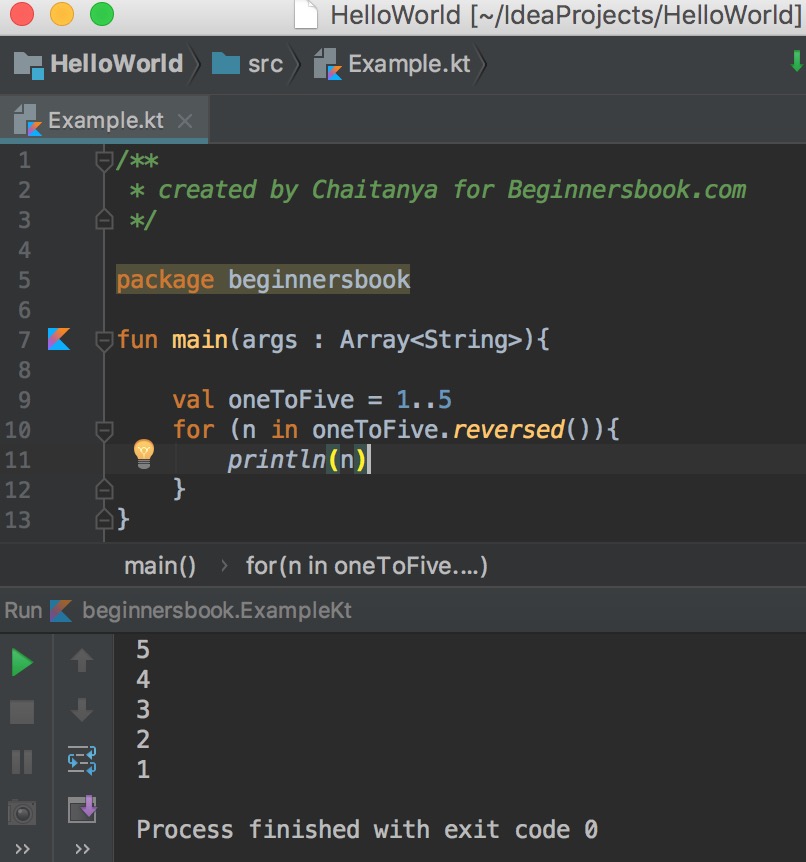
We can reverse a range in Kotlin using reversed() function.
/**
 * created by Chaitanya for Beginnersbook.com
 */

package beginnersbook

fun main(args : Array<String>){

    val oneToFive = 1..5
    for (n in oneToFive.reversed()){
        println(n)
    }
}
Output:
Leave a Reply