Arithmetic operators are used to perform arithmetic operations on the operands. For example, x + y is an addition arithmetic operation, where x and y are operands and + symbol is an arithmetic operator. C supports following arithmetic operators:
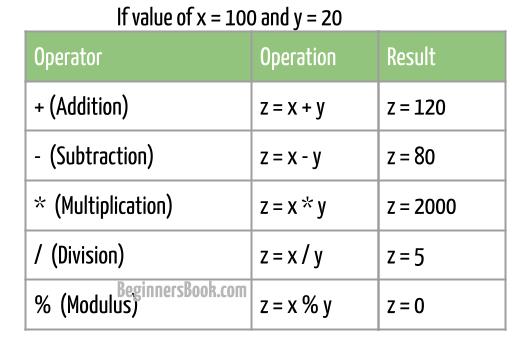
1. Addition(+) Operator Example
It adds two operands. In the following example, we have two integer variables and we are finding the sum of these numbers using + operator.
#include <stdio.h>
int main ()
{
  int x = 100, y =20;
  int sum;

  //Addition(+) operator
  //The addition result is stored in variable sum
  sum = x+y;

  //print result
  printf("Sum of %d and %d is: %d",x, y, sum);

  return 0;
}
Output:
Sum of 100 and 20 is: 120
2. Subtraction(-) Operator Example
The – operator is used for subtraction. Here, we are subtracting the value of y from the value of x. The subtraction result is stored in an int variable, which is displayed using printf() at the end of the program.
#include <stdio.h>
int main ()
{
  int x = 100, y =20;
  int sub;

  //Subtraction(-) operator
  //The result is stored in "sub"
  sub = x-y;

  //print subtraction result
  printf("x - y is: %d", sub);

  return 0;
}
Output:
x - y is: 80
3. Multiplication(*) Operator Example
The * operator is used for multiplication. It multiplies two operands as shown in the following program.
#include <stdio.h>
int main ()
{
  int x = 100, y =20;
  int product;

  //Multiplication(*) operator
  product = x*y;

  //print multiplication result
  printf("Multiplication of %d and %d is: %d", x, y, product);

  return 0;
}
Output:
Multiplication of 100 and 20 is: 2000
4. Division(/) Operator Example
The / operator, returns the quotient value after dividing left-side operand by right-side operand. For example, if 10 is divided by 5, then the / operator would return 2 (quotient).
#include <stdio.h>
int main ()
{
  int x = 100, y =20;
  int quotient;

  //Division(/) operator, it returns the quotient after
  //dividing x by y
  quotient = x / y;

  //print Division result
  printf("Quotient value after dividing %d by %d is: %d", x, y, quotient);

  return 0;
}
Output:
Quotient value after dividing 100 by 20 is: 5
5. Modulus(%) Operator Example
The % operator returns the remainder after dividing the left-side operand by right-side operand. For example, 10 % 2 would return 0 as 10 is perfectly divisible by 2.
#include <stdio.h>
int main ()
{
  int x = 100, y =20;
  int rem;

  //Modulus(%) operator, it returns the remainder after
  //dividing x by y
  rem = x % y;

  //print Modulus result
  printf("Remainder value after dividing %d by %d is: %d", x, y, rem);

  return 0;
}
Output:
Remainder value after dividing 100 by 20 is: 0