Java Math.cbrt() method returns cube root of a given double value. In this guide, we will discuss cbrt() method with examples.
public class JavaExample
{
  public static void main(String[] args)
  {
    double num = 27;
    System.out.println("Cube root: "+Math.cbrt(num));
  }
}
Output:
Cube root: 3.0
Syntax of Math.cbrt() Method
Math.cbrt(64); //returns 4.0
cbrt() Description
public static double cbrt(double num): Returns the cube root of the given number num.
cbrt() Parameters
It takes a single parameter:
- num: A double number whose cube root to be determined.
cbrt() Return Values
- Returns a double value, which is a cube root of the given number.
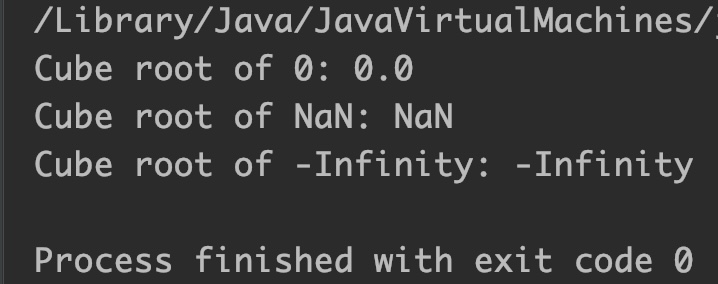
- If number is NaN (Not a number) then it returns NaN.
- If the given number is negative then it returns the cube root of absolute value with the negative sign.
- If the passed value is infinity, it returns infinity with same sign.
- If the passed value is zero, it returns zero with same sign.
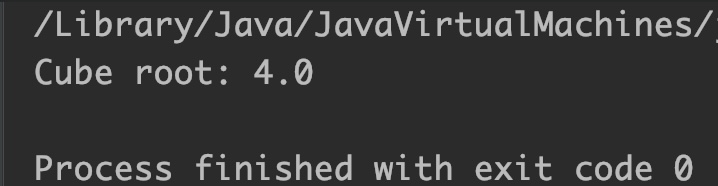
Example 1: Cube root of a given number
public class JavaExample
{
  public static void main(String[] args)
  {
    double num = 64;
    System.out.println("Cube root: "+Math.cbrt(num));
  }
}
Output:
Example 2: Cube root of a negative number
public class JavaExample
{
  public static void main(String[] args)
  {
    double num = -125;
    System.out.println("Cube root of -125: "+Math.cbrt(num));
  }
}
Output:

Example 3: Cube root of zero, NaN and infinity
public class JavaExample
{
  public static void main(String[] args)
  {
    double num = 0; //zero
    double num2 = 0.0/0; //NaN
    double num3 = -5.0/0; //negative infinity
    System.out.println("Cube root of 0: "+Math.cbrt(num));
    System.out.println("Cube root of NaN: "+Math.cbrt(num2));
    System.out.println("Cube root of -Infinity: "+Math.cbrt(num3));
  }
}
Output: